
A CoinStats alternative that never asks for an account
CoinStats is a good product and this page will not pretend otherwise. If you want automatic exchange sync, DeFi positions and tax reports, it does things cryptoc simply does not do. Here is the honest version of when you would pick which.
The one real difference
CoinStats syncs by connecting to your exchanges and wallets. To do that it holds a credential - an API key - and keeps a server-side copy of your positions. That is what makes the automation possible.
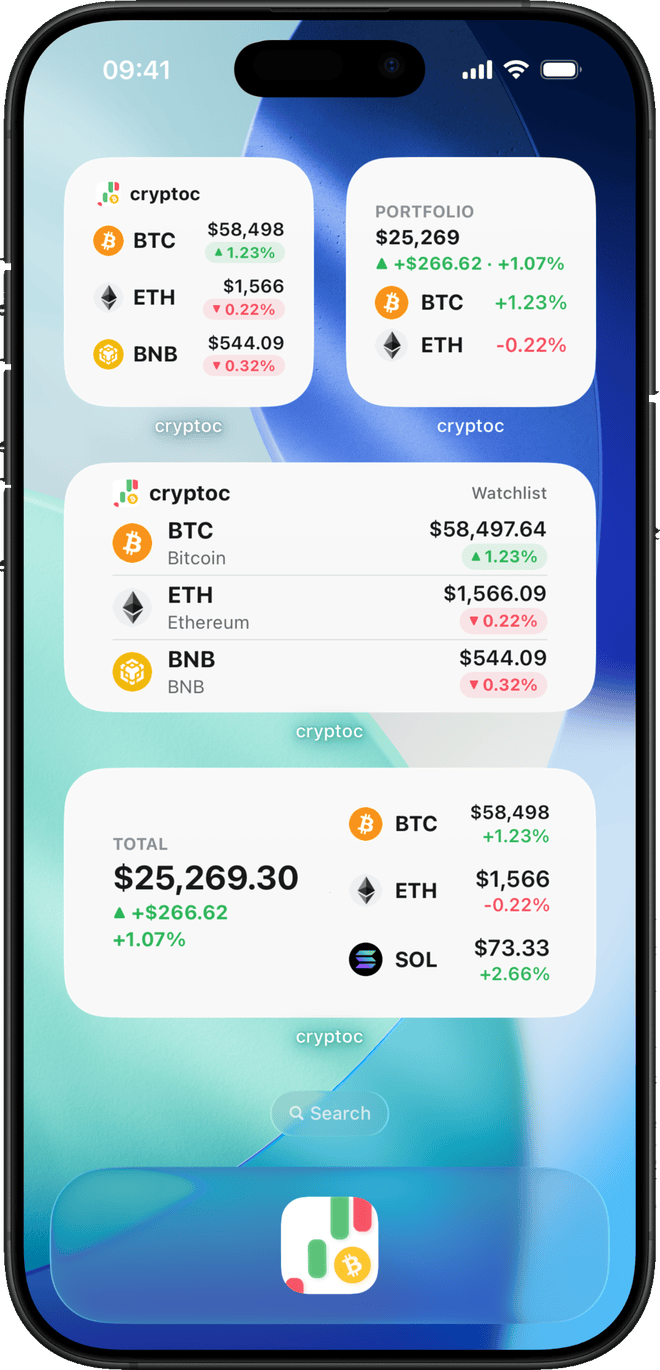
cryptoc has no sync, because it has no account and asks for no keys. You enter what you hold, and it never reaches our servers. Everything below follows from that one difference.
| Capability | CoinStats | cryptoc |
|---|---|---|
| Where CoinStats wins | ||
| Automatic exchange and wallet sync | Yes | No |
| DeFi positions | Yes | No |
| NFT tracking | Yes | No |
| Staking rewards | Yes | No |
| Tax reports | Yes | No |
| CSV import | Yes | Not yet |
| Coin coverage | Larger | 5,000+ |
| Where cryptoc wins | ||
| Works with no account at all | No | Yes |
| Never asks for exchange API keys | No | Yes |
| Holdings never reach the vendor's servers | No | Yes |
| No advertising SDKs | No | Yes |
| Usable free tier | Limited | Yes |
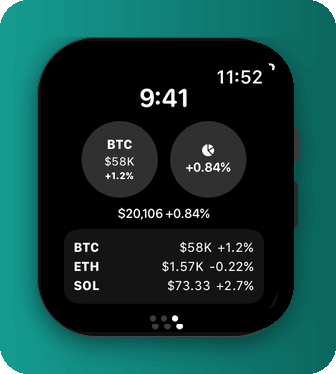
cryptoc's free tier is 3 holdings, 2 price alerts and every widget - home screen, lock screen and Apple Watch, the core of the product rather than a companion to it. And if you trade actively across several exchanges, typing by hand is genuinely worse: use CoinStats. This page would be dishonest if it told you otherwise.
What 2,258 CoinStats reviews actually say
These are percentages of angry written reviews, not of users. We clustered 2,258 written CoinStats reviews from the App Store and Google Play, August 2023 to August 2026; the figures below are shares of the 644 rated 1 or 2 stars.
Only about 2.5% of CoinStats' Play ratings carry any text, and the people who type are disproportionately upset. Anyone quoting these as "18.9% of CoinStats users lost data" is misreading them, and so would we be.
Bars drawn against a 20% axis. Share of 644 written 1-2 star reviews, not of users.
What they do show is what kind of thing goes wrong. The largest bundle - lockout, data loss, breach - describes failures only possible because a product holds an account and a credential. An app with no account cannot lock you out of one. That is not a claim about better engineering; it is a smaller surface.
Questions people actually ask
Can a read-only exchange API key be abused?
A correctly scoped read-only key cannot trade or withdraw. But keys often get created with more permission than intended, and even a read-only key exposes your full position and trade history to whoever holds it. The safest key is the one you never issued.
What happens to my holdings if a tracker changes its pricing?
With a cloud tracker your data sits behind their account system, so a pricing change is also an access question - the shape of the largest cluster above. On-device, a pricing change can cost you features, never access.
Is manual entry not just worse?
For an active multi-exchange trader, clearly. For someone with 5 to 15 coins that mostly sit still, you type it once and adjust a few times a year. That is the trade.
Does cryptoc send anything at all?
Yes, and pretending otherwise would be a lie you could catch with a network monitor. Price alerts are stored server-side to be evaluated against the market. Crash reports go to Bugsnag, purged after 7 days. Anonymous usage events go to AppMetrica (Yandex) against a random id for your copy of the app, and a widget sends that same id once a day so widget-only users still get counted. With market-move alerts on, the coin symbols you watch are stored so we know what to alert you about. Holdings and amounts never are. Full detail in the privacy policy.
There is nothing to sign up for
Free for 3 holdings, 2 price alerts and every widget.



Scan to install on your phone. The link opens the right store.